Gluten-free in Argentina: sin TACC, the ANMAT list, parrilla and milanesa
Short answer
In Argentina “sin TACC” means free of gluten from wheat, oats, barley and rye: TACC is the abbreviation Argentine law uses for those four grains1. Four checks:
- On a packaged food, look for the official “SIN GLUTEN” symbol and for the product listed as “Vigente” in ANMAT’s online list2. The legal limit is 10 mg of gluten per kg3; FDA says any unavoidable gluten present in a food labeled “gluten-free” is less than 20 ppm4.
- Treat oats as part of the question: they are one of the four TACC grains1, and the code’s definition of a gluten-free food names oats among the grains whose prolamins and glutelins it must not contain5. FDA requires oats labeled gluten-free to contain less than 20 ppm gluten6.
- In a restaurant or bar, the law requires at least one gluten-free (sin TACC) option7, 8. The Asociación Celíaca Argentina names shared utensils, cutting boards, toasters and frying oil among common cross-contact situations9, so ask about those. For the grill, the same charity says to set aside a space for the fresh meat when sharing an asado10.
- For milanesa, empanadas, pizza and alfajores, go by the recipe: the code defines milanesa as breaded or battered meat11, and its empanada dough definition starts from wheat flours and also allows flours of other cereals12.
- Gluten-free limit
- 10 mg of gluten per kg of food, set in article 1383 of the Código Alimentario Argentino3
- Oats
- Oats are one of the four TACC grains1, and a food sold as gluten-free must contain no prolamins and glutelins from oats, among the grains the code names5
- Celiac society
- Asociación Celíaca Argentina
Part of Travel: the Americas and Oceania, 10 guides
Key points
- TACC stands for wheat, oats, barley and rye (trigo, avena, cebada, centeno): the law and the Ministry of Health both list oats with the other three1, 13.
- Argentina’s limit for a food sold as gluten-free is 10 mg/kg3; FDA says any unavoidable gluten present in a food labeled “gluten-free” is less than 20 ppm4.
- A pack with the symbol should also be listed as “Vigente” in ANMAT’s list2. If it carries the symbol and cannot be found, ANMAT recommends that the celiac population avoid it14.
- Restaurants and bars are legally required to offer at least one gluten-free option7, 8. The text of article 4 bis does not say how a kitchen separates its grill and fryer7; the Asociación Celíaca Argentina names shared equipment as a cross-contact situation9, so ask.
- By definition a milanesa is breaded11, and an alfajor is built from cookies or baked doughs15: the recipe or the list entry decides.
What does “sin TACC” mean?
TACC appears in Argentina’s celiac law. It says the enforcing authority must set how much gluten “de trigo, de avena, de cebada o de centeno (TACC)” a food may contain to be classed as gluten-free1. In English that is wheat, oats, barley and rye, and “sin TACC” means without gluten from them1, 7.
The Ministry of Health describes celiac disease as triggered by proteins in wheat, oats, barley and rye, usually called gluten13. So the law and the Ministry list oats with the other three grains1, 13.
The law’s text pairs the two terms: it speaks of “un menú libre de gluten (sin TACC)”7. The words the code requires after the product name on a pack are “libre de gluten”16.
How does Argentina’s rule differ from FDA’s?
Both countries define gluten-free by a limit in the food, but the number and the label rules differ. The table gives each rule in its own words, oats included.
| Point | Argentina | United States |
|---|---|---|
| Limit | Gluten content “no podrá superar el máximo de 10 mg/Kg”3. ANMAT’s list describes it as a limit of 10 ppm17. | FDA says any unavoidable gluten present in a food labeled “gluten-free” is less than 20 ppm4. |
| Oats | A gluten-free food must contain no prolamins and glutelins from wheat, rye, barley or oats, among the grains the code names5. | Oats labeled gluten-free must contain less than 20 ppm gluten; they do not have to be certified6. |
| Claim on the pack | A food sold as gluten-free must carry the official symbol18 and the words “libre de gluten” after the product name16. | FDA’s rule sets requirements for the voluntary use of a “gluten-free” claim19. |
Check an Argentine pack against the Argentine rule. A US gluten-free label tells you about FDA’s limit, not Argentina’s4, 3.
How do I check a product in ANMAT’s list?
ANMAT’s Listado Integrado de Alimentos Libres de Gluten (LIALG, “ALG” for each food on it) brings together the gluten-free foods registered in Argentina, national and imported20. ANMAT’s buying rule has two parts that must both hold: the symbol on the pack and the product listed as “Vigente”2.
- Find the official symbol on the pack: a circle with a crossed bar over three ears of grain, with “SIN GLUTEN” on the bar18.
- Find the registration number on the label (RNPA, SENASA or, for bottled wine, INV)45. The list says the number is evidence that the health authority evaluated and authorized the product21.
- Search the list by that number, typed as printed on the label with its hyphens or slashes but without any dots between digits22.
- Read the status in the last column on the right: the product should be shown as “Vigente”23.
- No number on the pack, or no result? Some imported products enter under an import notice and carry no RNPA, SENASA or INV number; the help page says to search again by brand or sales name24, 54.
- Symbol on the pack but nothing in the list after every search? ANMAT’s help page recommends that the celiac population avoid buying or eating it14.
A listing can be withdrawn. ANMAT says a removal is provisional when, for example, cross-contact with gluten is found, and permanent when a product stops being sold25. For products you buy often, ANMAT suggests repeating the check from time to time26.
The symbol is changing
A rule published in December 2023 gave companies three years, until 2 December 2026, to adapt their labels to the new “SIN GLUTEN” logo, and ANMAT’s help page says that until then shelves can carry products with an earlier symbol or the new one27. The Ministry adds that the logo may be used only on foods within the code’s gluten limit28.
Imported products and apps
For imported foods, the Ministry says products over 10 ppm that hold a gluten-free certification from a country named in Annex III of Decree 35/2025 are shown differently in the official list and may carry the symbol and legends of their country of origin29. We did not read which countries Annex III names, so we cannot say whether a US certification mark counts.
The Asociación Celíaca Argentina points to two places to check a product: its own App Sin TACC and ANMAT’s search30. Its rule of thumb for people with celiac disease is to eat only foods with the health authorization that are correctly marked with the official symbol31.
The list can be filtered by product type, and the filter names categories such as alfajores, dulce de leche, ice cream, raw dough for pizza and empanadas, fresh pasta, fresh sausages, beer and yerba mate32. Use it to browse a category before you shop.
What must restaurants offer, and what is left to ask?
Ley 27.196 added article 4 bis to the celiac law, Ley 26.588. The establishments it lists must offer at least one food option or menu that is gluten-free (sin TACC), made under manufacturing conditions and nutritional requirements that the authority certifies7. The list includes restaurants and bars, food kiosks and concessions at terminals and transport stops, and fast-food outlets8.
The Ministry gives 14 June 2024 as the end of the phase-in for restaurants and bars, fast-food outlets, work canteens and transport-terminal kiosks33. The code adds that establishments obliged to offer a gluten-free option, whether the food comes from their own kitchen or an outside maker, must have implemented the guidelines of a guide of recommendations for a gluten-free menu that the code names34.
Article 4 bis sets the duty to offer an option; it does not itself describe how a kitchen separates a grill or a fryer7. The Asociación Celíaca Argentina names shared utensils, cutting boards, toasters, frying oil, containers and surfaces as frequent cross-contact situations9, and says contamination can happen in food-service establishments as well as in industry and at home35.
Questions the Gluten Intolerance Group, a US charity, suggests asking when eating out (in English; Spanish terms are in the last section):
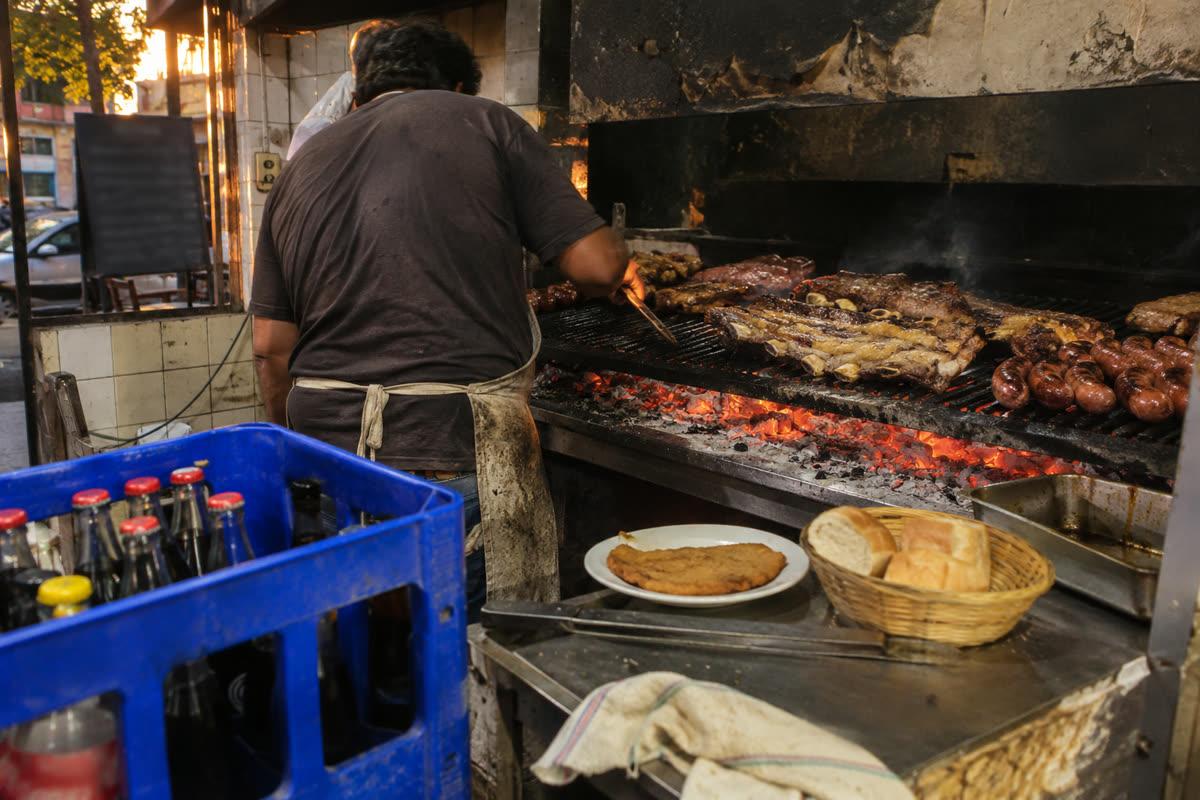
Parrilla and asado: what to check
The Ministry lists beef, chicken, fish and eggs among foods of natural origin that people avoiding gluten can eat38. What changes the picture is what else shares the grill and what is added to the meat.
The Asociación Celíaca Argentina’s advice for sharing an asado has two parts: use gluten-free sausages, or set aside a space on the grill for the fresh meat, and check that the seasonings are gluten-free10. That advice is about sharing an asado, not about a restaurant kitchen; in a restaurant the same questions are yours to ask: is there a reserved space on the grill, and what is in the sausage and the seasoning.
Sausage is the item to read. The code defines chorizo fresco as a fresh sausage of meat and bacon, with or without “otros ingredientes y aditivos de uso permitido”, so the definition leaves room for other ingredients39. The Ministry says to eat cold cuts and sausages in moderation and only from brands in the integrated list40, and ANMAT’s list has categories for fresh, cooked and dry sausages32. For what US sausage labels show, see our sausage verdict.
Milanesa, empanadas, pizza and pasta: check the recipe
For these four dishes the question is the recipe and the kitchen, not the name on the menu.
| Dish | What the sources say | What to look at |
|---|---|---|
| Milanesa | The code defines milanesa as a slice or fillet of meat that has been “rebozado o empanado”, breaded or battered11. The Ministry’s kitchen advice mentions oil used for foods breaded with pan rallado41, which the code defines as ground dry bread42. | The coating and the frying oil. Our verdict on breadcrumbs covers US breadcrumbs. |
| Empanadas | The code defines empanada dough as made from wheat flours and their derivatives “y/o harinas o derivados de otros cereales”, that is, and/or flours of other cereals12. ANMAT’s list has a category for raw dough for pizza, empanadas and tarts32. | The dough, wheat or another flour, and whether it is in the list. For flour in general, see our flour verdict. |
| Pizza | Pizza dough shares its list category with empanada dough32. | The crust. See our pizza verdict. |
| Pasta | The Ministry names water in which wheat-flour noodles were cooked as a cooking medium not to share with gluten-free food41. ANMAT’s list has separate categories for dry and fresh pasta, filled and unfilled32. | The pasta and the cooking water. See our pasta verdict. |
Polenta is the contrast case: maize is on the Ministry’s list of gluten-free grains and starches43, and our polenta verdict covers cornmeal. A polenta dish can still share a pan or a sauce, so the cross-contact questions above apply.
Alfajores, dulce de leche and ice cream
In the code’s definition an alfajor is two or more cookies, crackers or baked doughs joined by fillings such as jams, jellies or sweets, and it may be coated15. The definition does not name the flour, so the ingredient list or the list entry decides.
ANMAT’s list has a category for alfajores and a separate one for dulce de leche, plus ice cream and ice-cream cakes32. For what US labels show on the same foods, see our cookies verdict and ice cream verdict.
Wine, beer, fernet and mate
Wine: the Instituto Nacional de Vitivinicultura (INV) is one of the bodies whose registrations feed ANMAT’s list44, and a bottled wine’s INV number is a seven-digit number that corresponds to the analysis of the bottled wine45. For what wine is made from, see our wine verdict.
Beer: the code defines beer as the drink made by fermenting, with brewer’s yeast, a wort of malted barley or malt extract, with hops46. ANMAT’s list has a beer category32. See our beer verdict.
Fernet and mate: the list has categories for alcohols and related drinks and for yerba mate and related products32. We found no source that states the gluten status of fernet or mate as drinks, so check the brand in the list.
Shopping: closed packs, the deli counter and flours
The Ministry advises avoiding loose or bulk products and choosing closed packs: foods such as dried fruit and legumes contain no gluten naturally but can pick it up in the open47. The Asociación Celíaca Argentina adds that sliced cheeses and cold cuts should be bought in places that ensure the necessary care48.
The Ministry names these gluten-free grains and starches: maize, rice, amaranth, buckwheat, quinoa, millet, carob, chickpea, bean and soy flours, potato starch and cassava starch43. For flours, premixes and products made from them, it says to choose brands from the official list49.
If you cook in a rental, the Ministry says not to let prepared milanesas or other breaded products touch other meat50.
Words to know, and what to hand over
We do not write Spanish sentences for you: no source we could open supplies an Argentine restaurant question. These are terms the Argentine sources themselves use.
| Term | Where it appears | What it points to |
|---|---|---|
| sin TACC | Ley 27.196: “un menú libre de gluten (sin TACC)”7; the Asociación Celíaca Argentina’s App Sin TACC30 | TACC stands for wheat, oats, barley and rye1. |
| libre de gluten | The words that follow the product name on a pack16 | The legal claim on a packaged food. |
| SIN GLUTEN | The legend on the bar across the official symbol18 | The symbol to find on the pack. |
| Vigente | The status ANMAT’s list should show for the product2, 23 | The second check after the symbol. |
| contaminación cruzada | The Ministry’s term for a food without gluten becoming contaminated by contact with other foods or shared utensils51 | The cross-contact questions in this guide. |
The Gluten Intolerance Group’s Spanish restaurant card (Ficha para Restaurantes) says people with these disorders should not eat oats unless they are certified or labeled gluten-free52. It is a Spanish-language card from a US charity, and it does not use the term TACC53; if you hand it over, add the term yourself. For general restaurant phrases, see our Spanish and Portuguese phrase guide.
Verdicts in this guide
 BreadcrumbsContains glutenchecked Nov 16, 2026
 SausageDepends on the product2 of 7 products we checked contain gluten: Field Roast Italian Garlic & Fennel Plant-Based Sausages and Tofurky Plant-Based Italian Sausagechecked Nov 16, 2026
 PizzaContains glutenchecked Nov 16, 2026
 PastaContains glutenchecked Nov 16, 2026
 FlourContains glutenchecked Nov 16, 2026
 PolentaNaturally gluten-freeBuy it labeled gluten-freechecked Nov 16, 2026
 CookiesContains glutenchecked Nov 16, 2026
 Ice creamDepends on the product7 of 11 products we checked contain glutenchecked Nov 16, 2026
 WineNaturally gluten-freechecked Nov 16, 2026
 BeerDepends on the product2 of 5 products we checked contain gluten: Guinness Draught and Lagunitas The Legendary IPAchecked Nov 16, 2026
Questions people ask
Is “sin TACC” the same as “libre de gluten”?
The law’s text pairs them: “un menú libre de gluten (sin TACC)”7. On a packaged food, the code asks for the words “libre de gluten” after the product name and for the official symbol16, 18.
What is Argentina’s gluten limit?
Article 1383 of the Código Alimentario Argentino sets a maximum of 10 mg/Kg3, which ANMAT’s list calls 10 ppm17. FDA says any unavoidable gluten present in a food labeled “gluten-free” is less than 20 ppm4.
Are oats allowed in Argentina’s gluten-free foods?
Argentine law lists oats among the four TACC grains1, and the code’s definition names oats among the grains whose prolamins and glutelins a gluten-free food must not contain5. FDA requires oats labeled gluten-free to contain less than 20 ppm gluten6.
Do restaurants in Argentina have to offer a gluten-free option?
Ley 27.196 requires restaurants and bars, among others, to offer at least one gluten-free (sin TACC) option7, 8. The Ministry gives 14 June 2024 as the end of the phase-in for restaurants and bars33. Whether a kitchen separates its grill and fryer is a question for that restaurant.
More in Travel: the Americas and Oceania
 Gluten-free in Brazil: the “contém glúten” line, pão de queijo, farofa and tapiocaHow to read Brazil’s mandatory “contém glúten” line, and how to judge pão de queijo, farofa, tapioca and fried snacks by recipe and kitchen.
 Bringing gluten-free food into Canada, Mexico, Australia and New ZealandWhat a US traveler can carry into Canada, Mexico, Australia and New Zealand: declare food, pack to each country’s list, and know what to buy there.
 Gluten-free in the Caribbean: island dishes, jerk labels and cruise port daysWhich Caribbean doughs, soup mixes and jerk sauces list wheat, what a cruise line’s dietary request covers on a port day, and what to ask.
 Gluten-free in New Zealand: the shared food code, oats, Marmite and the borderWhat a US visitor needs for gluten-free food in New Zealand: the shared Australian claim, oats, Marmite, Coeliac NZ marks and border declaration.
 Gluten-free in Mexico: tortillas, Maggi seasonings and the Mexican allergen lineTell a corn tortilla from a corn-and-wheat blend, spot the Maggi seasonings that list wheat, read the Mexican allergen line and ask about the griddle.
 Gluten-free in Peru: chifa soy sauce, bread in the sauce and Ley 31881Where wheat enters Peruvian cooking (sillao in chifa dishes, bread in sauces), what Peru’s gluten-free label law settles, and how to plan trek meals.
Related guides
 Gluten-free logos outside the US: who issues each one and what it requiresTell a certifier’s gluten-free logo from a maker’s own: who issues Crossed Grain, Coeliac Australia’s and Celiac Canada’s marks, and the limit each sets.
 Ordering gluten-free at an Italian restaurantBefore you order at an Italian restaurant: where the gluten-free pasta is boiled, what thickens the sauces, and what is breaded or fried.
 Gluten-free substitutes: the swap for each wheat ingredient and the label check it needsA lookup table of gluten-free swaps for wheat flour, pasta, bread, soy sauce, beer and more, with the one label check each swap needs.
 Who regulates a gluten-free claim: FDA, USDA or TTBWhich agency sets the rules for a gluten-free claim on packaged food, meat, eggs, beer, wine and spirits, and what to check when a label is unclear.
Sources
- [1, 7, 8] Honorable Congreso de la Nación Argentina (texto en argentina.gob.ar), Ley 27.196: Enfermedad celíaca, modification of Ley 26.588, checked Nov 17, 2026.
- [2, 32] ANMAT (Argentina), Listado Integrado de Alimentos Libres de Gluten: inicio, checked Nov 17, 2026.
Read on 2026-11-17: the “Tipo de Producto” filter on the list’s home page names, among others, ALFAJORES; DULCE DE LECHE; HELADOS Y TORTAS HELADAS; MASAS CRUDAS PARA PIZZA, EMPANADAS, TARTAS Y SIMILARES; PASTAS FRESCAS RELLENAS; PASTAS FRESCAS SIN RELLENO; PASTAS SECAS RELLENAS; PASTAS SECAS SIN RELLENO; CHACINADOS EMBUTIDOS FRESCOS; CHACINADOS EMBUTIDOS COCIDOS; CHACINADOS EMBUTIDOS SECOS; CERVEZAS; ALCOHOLES Y AFINES; and YERBA MATE Y AFINES.
- [3, 5, 16, 18, 34] Argentina: Código Alimentario Argentino (argentina.gob.ar), Código Alimentario Argentino, Capítulo XVII, artículo 1383 (alimentos libres de gluten), checked Nov 17, 2026.
- [4, 6, 19] US Food and Drug Administration, Questions and Answers on the Gluten-Free Food Labeling Final Rule, checked Nov 17, 2026.
- [9, 10, 30, 31, 35, 48] Asociación Celíaca Argentina, Alimentación sin gluten, checked Nov 17, 2026.
- [11, 39] Argentina: Código Alimentario Argentino (argentina.gob.ar), Código Alimentario Argentino, Capítulo VI, artículo 354 tris (milanesa), checked Nov 17, 2026.
- [12, 15, 42] Argentina: Código Alimentario Argentino (argentina.gob.ar), Código Alimentario Argentino, Capítulo IX, artículo 711 (masa para empanadas), checked Nov 17, 2026.
- [13] Ministerio de Salud de la Nación (Argentina), ¿Qué es y cómo se trata la enfermedad celíaca?, checked Nov 17, 2026.
- [14, 22, 23, 24, 26, 27, 54] ANMAT (Argentina), Listado Integrado de Alimentos Libres de Gluten: ayuda, checked Nov 17, 2026.
- [17, 20, 21, 25, 44, 45] ANMAT (Argentina), Listado Integrado de Alimentos Libres de Gluten: preguntas frecuentes, checked Nov 17, 2026.
- [28, 29, 33] Ministerio de Salud de la Nación (Argentina), Legislación (celiaquía), checked Nov 17, 2026.
- [36, 37] Gluten Intolerance Group, What are some of the most important questions to ask the wait staff or management of a food service or restaurant?, checked Nov 17, 2026.
- [38, 40, 43, 49] Ministerio de Salud de la Nación (Argentina), Alimentación saludable sin gluten, checked Nov 17, 2026.
- [41, 47, 50, 51] Ministerio de Salud de la Nación (Argentina), Contaminación cruzada: ¿qué es y por qué es tan importante?, checked Nov 17, 2026.
- [46] Argentina: Código Alimentario Argentino (argentina.gob.ar), Código Alimentario Argentino, Capítulo XIII, definición de cerveza, checked Nov 17, 2026.
- [52, 53] Gluten Intolerance Group, Ficha para Restaurantes (Spanish restaurant card), checked Nov 17, 2026.
Read on 2026-11-17: the card, a Spanish-language page from a US charity, names wheat, rye, barley and oats and lists possible sources of gluten such as pasta, flour, soy sauce and malt; the abbreviation TACC does not appear on it.